Silver holds a unique position within metals. Through both its industrial use case and its appeal as a store-of-value, it combines the inclinations of industrial metals and precious metals. In this article, we’ll be going deeper into its nuances to understand all the factors that drive prices and discuss actionable strategies for trading it.
Trading Silver through Contracts for Difference
Before diving into the specifics of silver, a solid understanding of how CFDs work and how they differ from buying futures contracts is required. These are some of the key features of trading through a CFD:
- A CFD is a cash-settled derivative. This means you never physically buy, sell, or take delivery of any goods. You are speculating on a contract that is made to track the prices of silver futures in major markets. Using a CFD thus allows you to speculate on prices without ever having to worry about rolling over a futures contract or undertaking physical delivery.
- CFDs allow you to use leverage, enabling you to use your capital more effectively. Using leverage wisely allows you to hold multiple positions at a time without tying up all your capital in just one asset. It also allows you to size up positions and potentially make significant profit from intraday swings that would otherwise achieve only a small percentage gain. Leverage is a tool; when used wisely, it can amplify potential returns, but if used without understanding, it can also increase the size of losses.
- Unlike a physical investment, holding a CFD position past the daily market close typically incurs an overnight financing charge (or 'swap fee'). This cost makes holding positions for extended periods less profitable. Therefore, the strategies discussed below are suited more for short to medium-term trades instead of longer-term investments.
Understand Silver’s Dual Role
Silver as a Precious Metal
Due to silver’s unique dual-utility, we’ll split up Silver’s fundamentals into both categories.
In its role as a precious metal, silver is a high-beta alternative to Gold. In finance, Beta measures an asset's volatility relative to the broader market. When silver is described as a high-beta alternative to gold, it fundamentally means that silver's price movements will typically be more volatile or exaggerated than those of gold.
This dynamic is reinforced by the high positive correlation between gold and silver. For instance, looking at daily logarithmic returns over one year, this correlation currently sits near 0.69.
Since silver thus follows Gold prices closely, we can also assume that a lot of the factors that are relevant for Gold prices are relevant here. These precious metal fundamentals can be briefly summarized as:
- Inversely correlated with Real Yields (Interest Rates when accounting for inflation)
- Inversely correlated with the U.S. Dollar Index (DXY)
- Correlated with inflation, and more importantly, inflation expectations
We offer a deeper dive into each of these factors, complete with illustrative examples, in our dedicated Gold article, which we highly recommend checking out.
Silver as an Industrial Metal
Silver’s demand is evenly divided between its role as a precious metal and its use in industrial and high-tech applications. It is especially valued for having the highest electrical and thermal conductivity of all metals.
Because of this, it also trades like industrial metals, which have the following key characteristics:
- Pro-cyclical behavior
- Correlated to Equities
The Demand-Side
A significant driver of industrial demand is the solar energy sector. Silver paste is crucial for creating the electrical contacts that enable photovoltaic technology to convert sunlight into electricity. Due to the global push for a 'Green Revolution', silver demand from this sector is projected to continually increase.
Furthermore, supply forecasts indicate a severe tightening in the silver market. Some models suggest that by 2030, the demand for silver from the photovoltaic industry alone could potentially exceed the entire global silver supply. This outlook creates a strong, long-term bullish tilt for silver prices, as this demand is driven by global policy and technological necessity, rendering it relatively price-insensitive. Since no commercially viable substitute currently exists for silver's superior conductivity and photovoltaic properties, industrial users are compelled to continue utilizing it, even if prices appreciate significantly.
The Supply-Side
Interestingly, silver is rarely mined as a primary commodity. Instead, an estimated 70-80% of all silver mined globally is a byproduct of extracting other base metals, predominantly copper, lead, and zinc.
Thus, only 20-30% of global silver production comes from primary silver mines, and this share has been declining.
Because its production is mostly a secondary function, the supply is determined entirely by the profitability of mining for other metals (mainly copper, zinc, and lead). This dynamic makes silver supply inelastic to price in the short term. If Silver sees strong price increases, producers are unable to quickly increase production because they aren’t mining for silver in the first place. This supply dynamic allows for parabolic runs, since the market is unable to increase the supply in a significant manner (at least in a short timeframe), and silver has more room to keep appreciating.
On top of the inelastic supply structure, silver markets are currently experiencing tight physical inventories, which only exacerbates the volatility of potential bull runs. Monitoring these physical stocks is vital, as they represent the only part of the supply that can be quickly released to the market. If prices were to jump by 20% over two weeks, owners of physical inventory might rapidly sell to cash in their profit. However, if this physical inventory is already very limited, there is barely any selling pressure to dampen the rally, which can help push prices up further in the short term.
Silver’s Unique Trading Nuances
Amplified Volatility
As we already mentioned, silver sees significantly higher volatility than Gold, but just how much more? Let’s take a look at this chart:
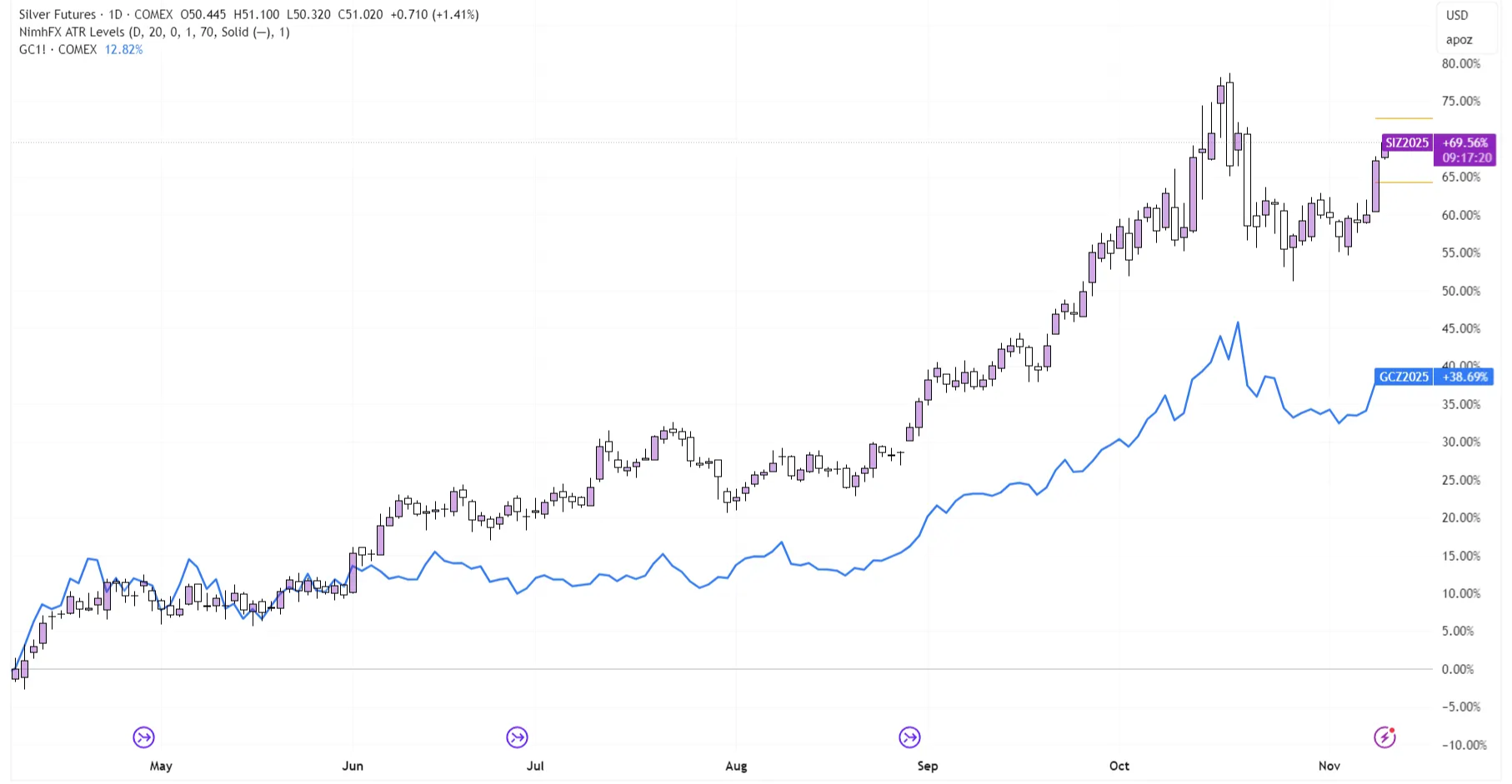
Silver prices compared to Gold prices from April-November 2025
Both assets experienced a strong rally, but Silver’s percentage return was notably higher than Gold’s. This greater volatility is evident across different timeframes, from weekly charts down to minute charts. However, there are periods when Silver may experience temporary lower volatility.
For example, during a pullback, Gold might retrace more sharply, suggesting stronger underlying buying pressure in Silver.
The main reason for Silver’s higher volatility is its smaller market size. At the time of writing, Silver’s market capitalization is roughly 10% of Gold’s. In larger markets, the capital needed to achieve the same percentage increase grows exponentially rather than linearly, making smaller markets like Silver more sensitive to significant capital flows.
Trading the Dual Correlation
The main challenge in trading Silver is managing its dual role as both an industrial and a precious metal. While industrial and safe-haven demand each account for roughly 50% of total demand, this does not mean Silver behaves exactly halfway between the two.
In practice, industrial demand provides a steady price floor but rarely drives sharp price movements. Instead, investors and speculators on financial markets are the primary movers, as shown by Silver’s strong correlation with Gold. If Silver were truly halfway between a base and a precious metal, it would show moderate correlation with both Gold and Copper. In reality, it is largely uncorrelated with Copper and closely tracks Gold.
A practical way to understand this duality is by looking at different timeframes:
- Medium to short term: Silver acts as a Gold proxy, reacting mainly to U.S. Dollar strength, real yields, and inflation; behaving like a safe-haven asset.
- Long term: Silver behaves more like Copper and other base metals, with its overall trend driven by industrial demand. It becomes pro-cyclical, moving in line with equities over time.
Trading the Gold/Silver Ratio
Given that silver is highly correlated with gold and is often seen as its more volatile "younger sibling," it makes strategic sense to track the price of silver expressed in terms of gold, in addition to the standard XAGUSD pair. Pricing assets in the form of other assets is an incredibly overlooked tool. It allows us to look at the worth of an asset and compare it to another hard asset, rather than fiat currencies, which are constantly being debased.
We can then use simple technical analysis on this chart, and use these insights either for directional trading in Silver, or relative-value trading, where you’re offsetting direct market exposure by opening a multi-leg trade. Simple Technical Analysis tends to work better on these cross pairs, with cleaner price action. Where fiat-denominated pairs often show messy Support/Resistance areas, with price venturing just beyond a key area, to then move into the other side, relative pairs have S/R zones that seem to work much more precisely. Let’s take a look at this GOLD/SILVER chart, which shows the number of ounces of Silver you need to buy one ounce of Gold:
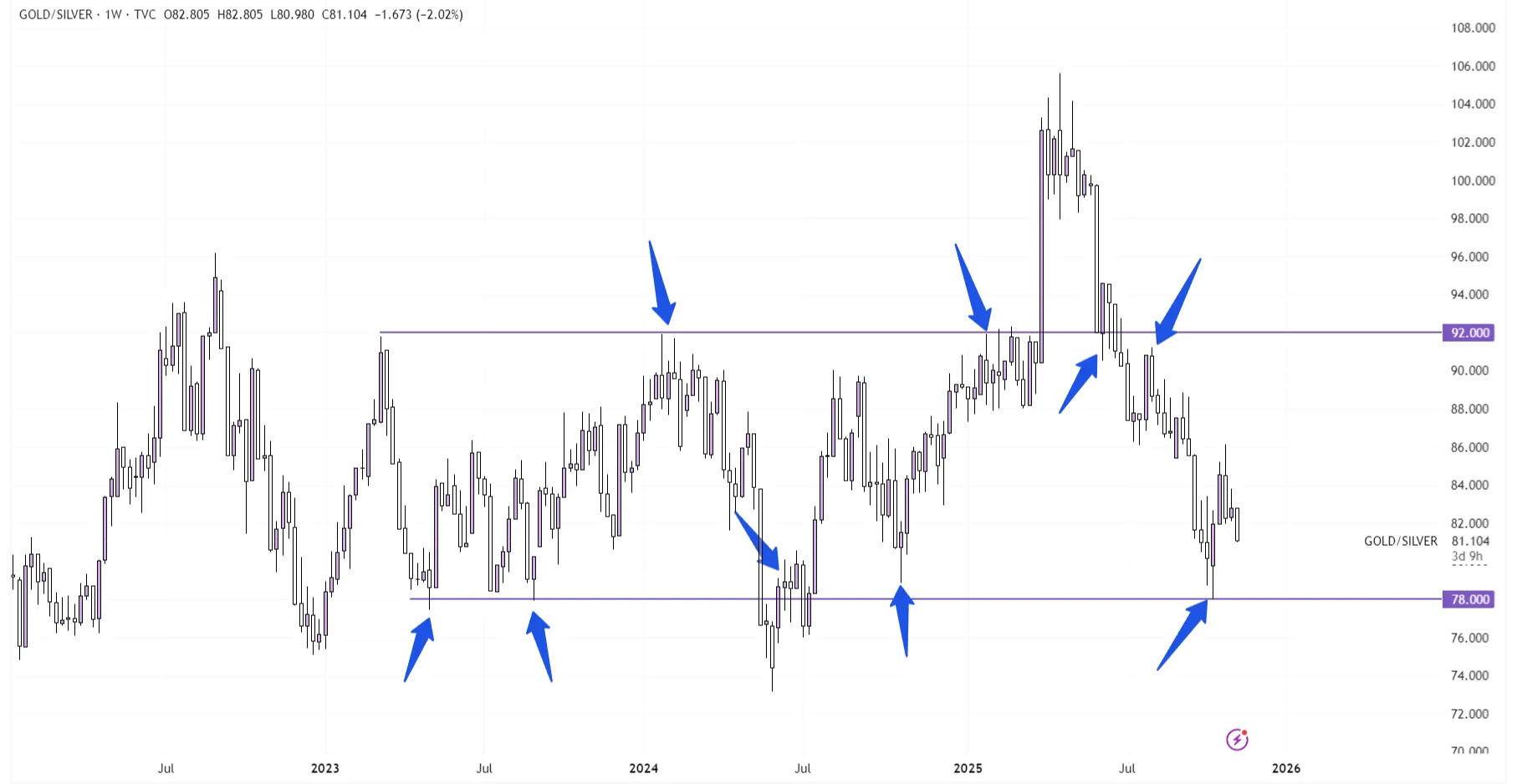
GOLD/SILVER Chart on the Weekly timeframe
On this chart, two major areas stand out: the 78 and 92 levels. Both of these have given extremely accurate reactions from both sides, often holding up multiple times before being broken, then seeing a clean break out, after which price accepts back into the range by testing the key level from the opposite side and then rotating towards the other side of the range.
While this dynamic is certainly present across fiat-denominated pairs, the price action is rarely as clean and precise as in these cross-asset pairs. For comparison, this is what the XAGUSD chart (Silver against the U.S. Dollar) looks like over the same timeframe:
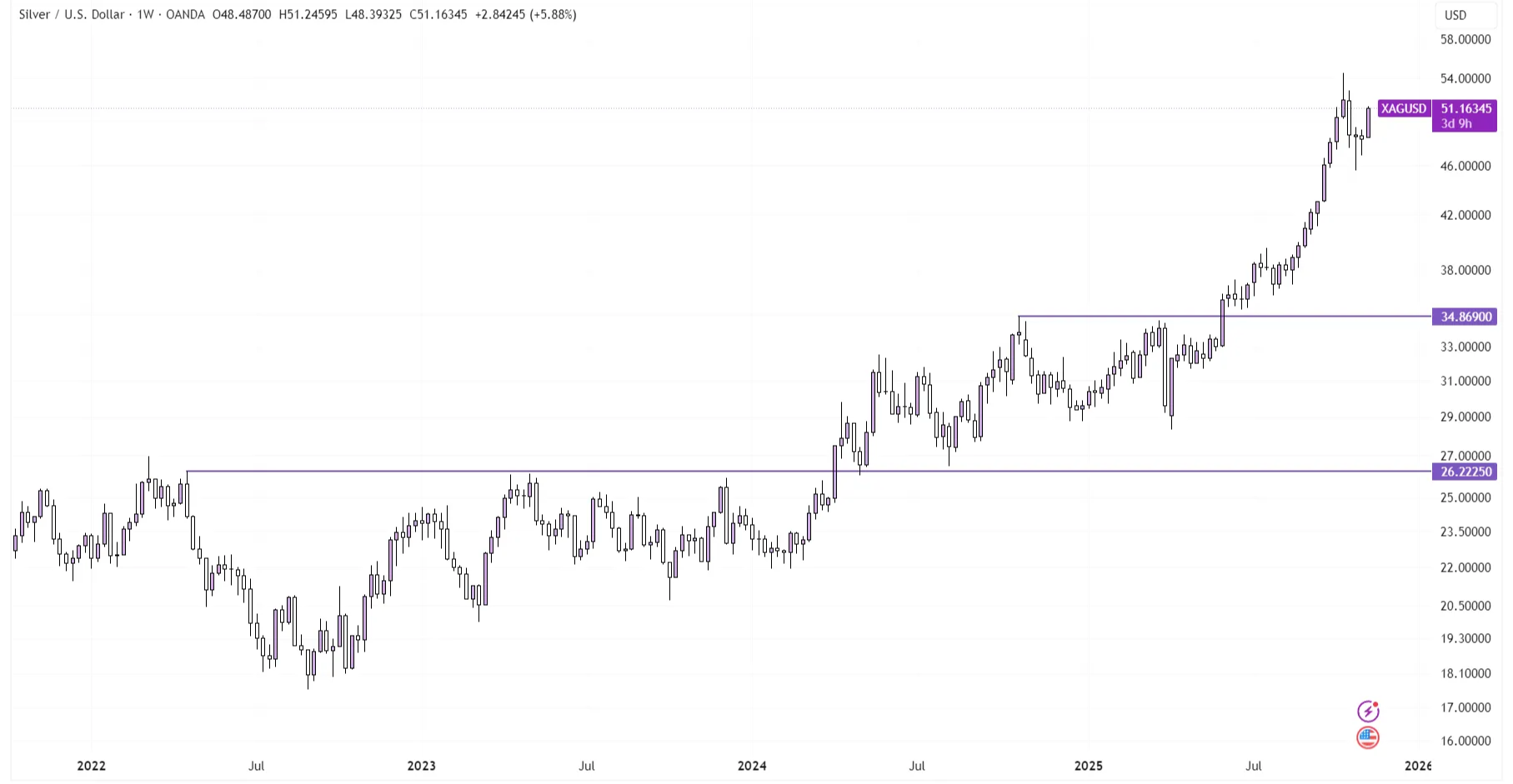
XAGUSD Chart on the Weekly Timeframe
Although the general approach remains consistent, the reactions at specific price levels are far less precise. With the exception of the $26 level, most areas are not nearly as exact as those on the GOLD/SILVER chart. You can definitely still see major Support and Resistance areas, but this lack of precision can make a big difference in potential profits as a trader.
A fundamental concept in trading is defining a price point where you can confidently say your trade idea has failed; this is where you place your stop loss.
Let's examine the above two charts as an example.
On the GOLD/SILVER ratio chart, the 73 level is highlighted as an area of interest. This level has shown precise reactions in the past, making it a potential entry point for a long position, with a limit order to buy at 73 and a stop loss at 72. If the price falls below 72, the trade idea is invalidated, as further declines could follow.
For a similar trade in XAGUSD, the $54 level might serve as a short entry. However, because XAGUSD often probes beyond key levels, the stop loss may need to be much wider, possibly around $57, to avoid being prematurely stopped out before the price moves toward the target.
The GOLD/SILVER chart allows for tighter stop losses, which can lead to trades with a higher risk-to-reward ratio. Viewing Silver in terms of Gold offers an alternative perspective, pricing it against another hard asset rather than a fiat currency.
However, these relative value approaches also have their merit, as you can offset any direct market exposure (Gold and Silver USD prices might drop as Silver is appreciating compared to Gold). These relative-value approaches are popular in hedge funds and can generate significant, uncorrelated returns if executed with precision, although they can be complex to manage.
Conclusion
We have explored the unique aspects of trading Silver: its dual role as both an industrial and a precious metal, its demand-driven yet supply-inelastic structure, and its strong bullish demand fundamentals.
You now also understand the advantage of pricing Silver not only in U.S. Dollars but in terms of Gold. This approach provides a deeper insight into how Silver’s value is truly changing, compared to looking only at an XAGUSD chart.
Take your understanding of Silver further and see how these insights can solidify your trading decisions.