Introduction
The Middle East conflict is dwindling ever so slightly, which gave equities the little fuel they needed to push for new highs. Meanwhile, the Australian dollar is completing one of the cleanest head-and-shoulders patterns ever. Meanwhile, the Yen gained 5.3% in five days’ time. Join us as we help you prepare for the week ahead.
Global Macro
The only notable macro event of this week will be the NFP report, which is yet to be released. Instead, we’re going to do a quick look at the implied rate path for the Fed until the end of the year, as the odds have been shifting quite aggressively lately.
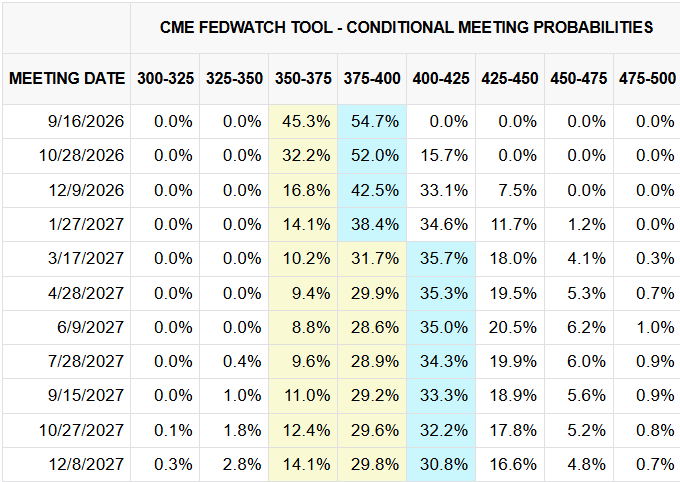
Aggregated Odds of where Fed interest rates will land by end of year, for reference current rates are 350-375
For September’s meeting, the odds of a 25 bps hike versus a hold are about 50/50. However, taking into account that September 16 is still a long way to go, we will have two more NFPs, two more CPIs and two more PCE data reports. In other words, lots of data that can throw these odds around several times.
What’s also notable is that while December still has 375-400 as most likely, 400-425 is a much closer second than our current rates, implying that the odds of rates landing at 400-425 are almost twice as high as rates staying where they are by the end of the year.
Equities
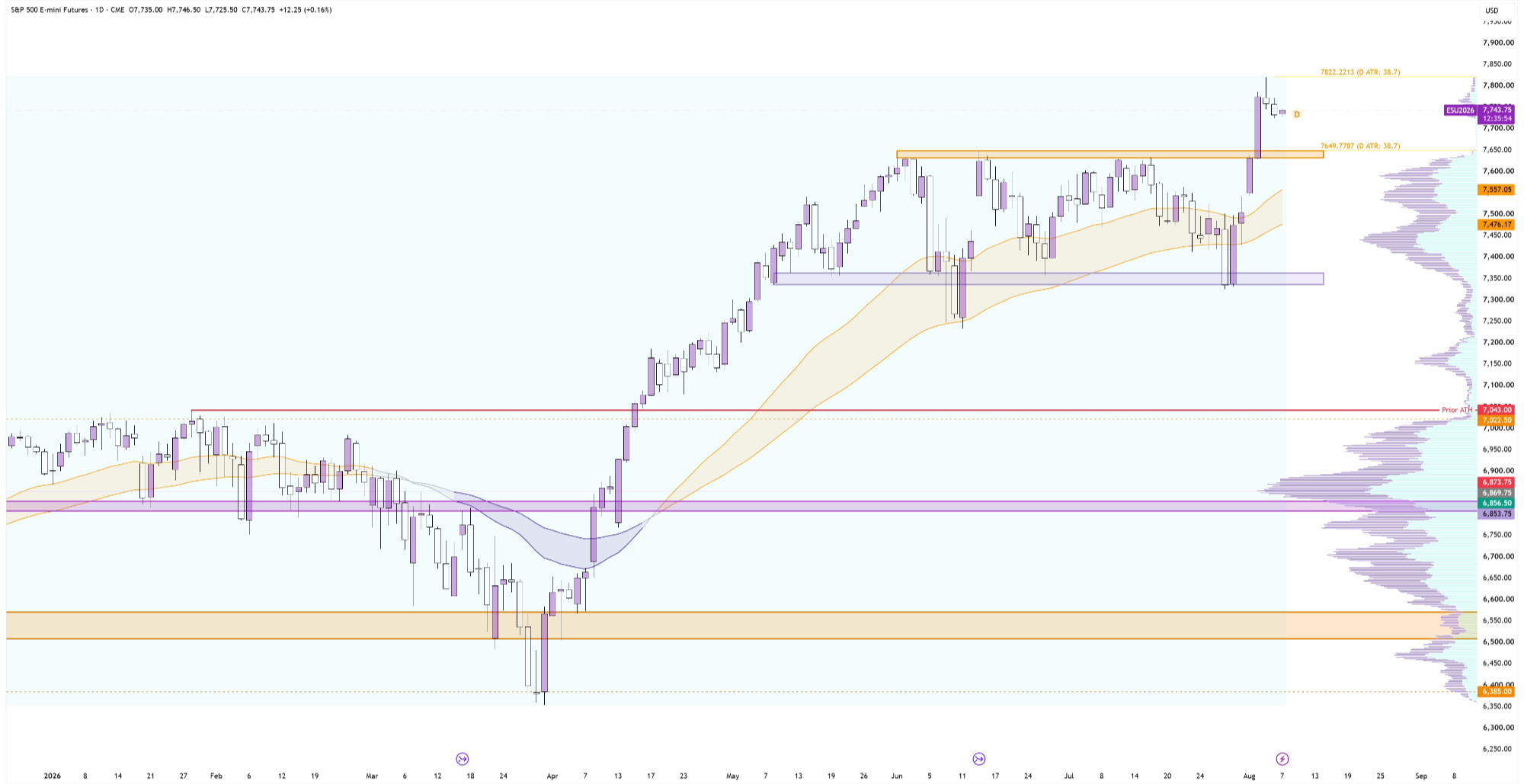
Stocks had a very solid week across the board, as the AI trade is still not done. Despite some protests, the majority of the market still believes the investments in AI will pay off.
S&P 500 on the Daily Timeframe
This led to fresh all-time highs on the S&P 500, Euro Stoxx and DAX, while the Nasdaq and Nikkei, despite their solid week, still have more work to do. In the Nikkei, part of the recent weakness is also explainable by remembering that the Yen has had a very strong two weeks, ever since the joint US–Japan market interventions.
For the S&P 500 specifically, we want to watch $7,648 as the prior ATH, which should now function as support. Hold there, and further highs become the base case for possibly another leg up in this bull run.
Forex
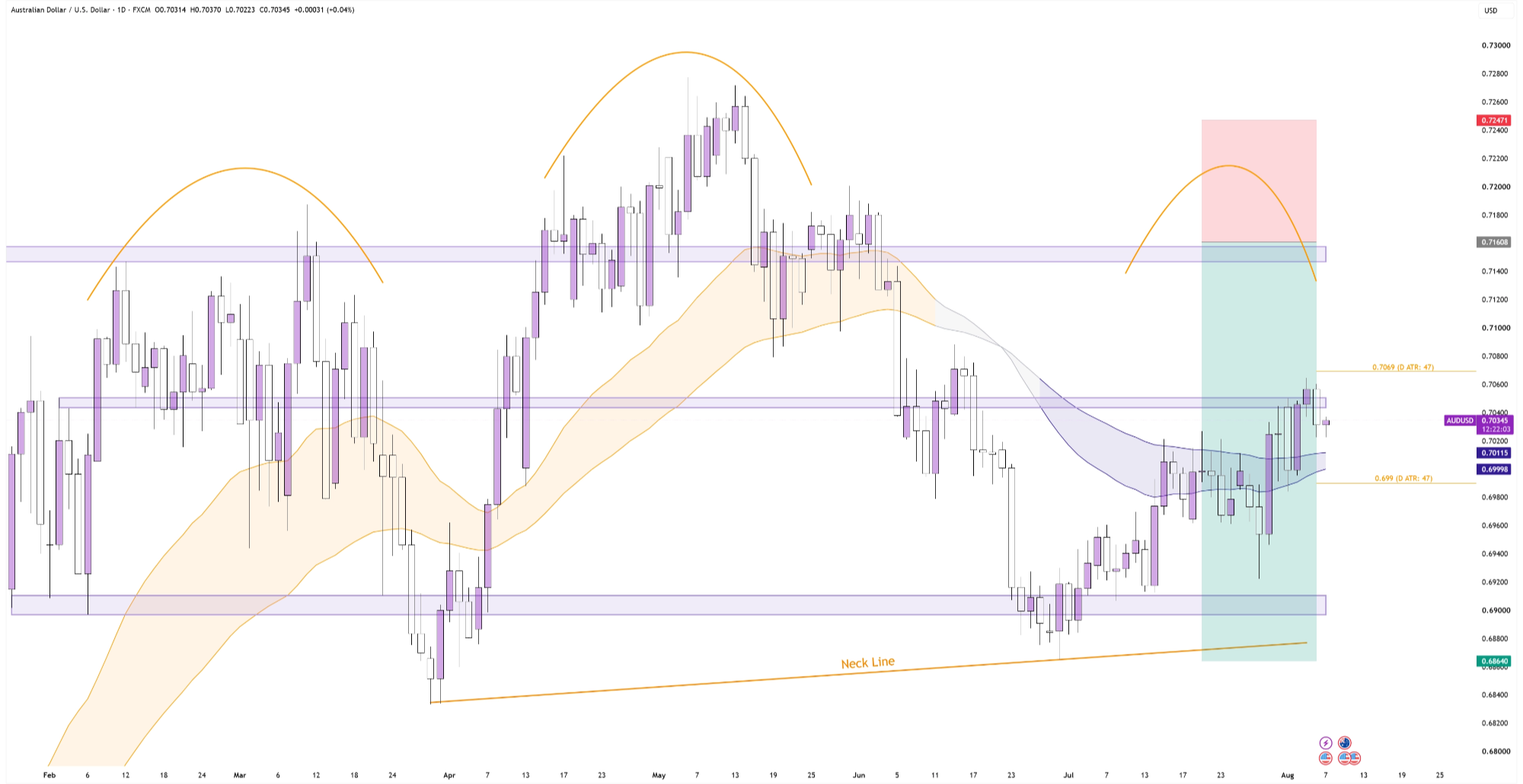
While most of the attention is still on the Yen, we’re seeing more interesting opportunities appear in the Aussie, where a multi-month head and shoulders pattern is set to play out in the near future.
AUD/USD on the Daily Timeframe
Ever since February, this chart has been forming a textbook H&S pattern, as we are now seemingly ramping up into the right shoulder. If the head and shoulders pattern were to come to fruition, there’s two main ways you could join the move:
- Pre-empting the right shoulder: The riskier, but highest RR move. If you see any bearish price action appearing around 0.715, you could short all the way down to the neckline, or if you’re particularly brave, for a completion of the H&S pattern. This is high risk, high reward.
- Shorting the break of the neckline: The higher hit rate option. Here you would simply wait until price breaks 0.688 (currently where the neckline comes in) and open a short targeting a 400 pip move down. You get this target by measuring the distance between the top of the head and the neckline (400 pips), and then using that number to extend downwards from the neckline. In this case it would give a final downside target of 0.648.
Commodities
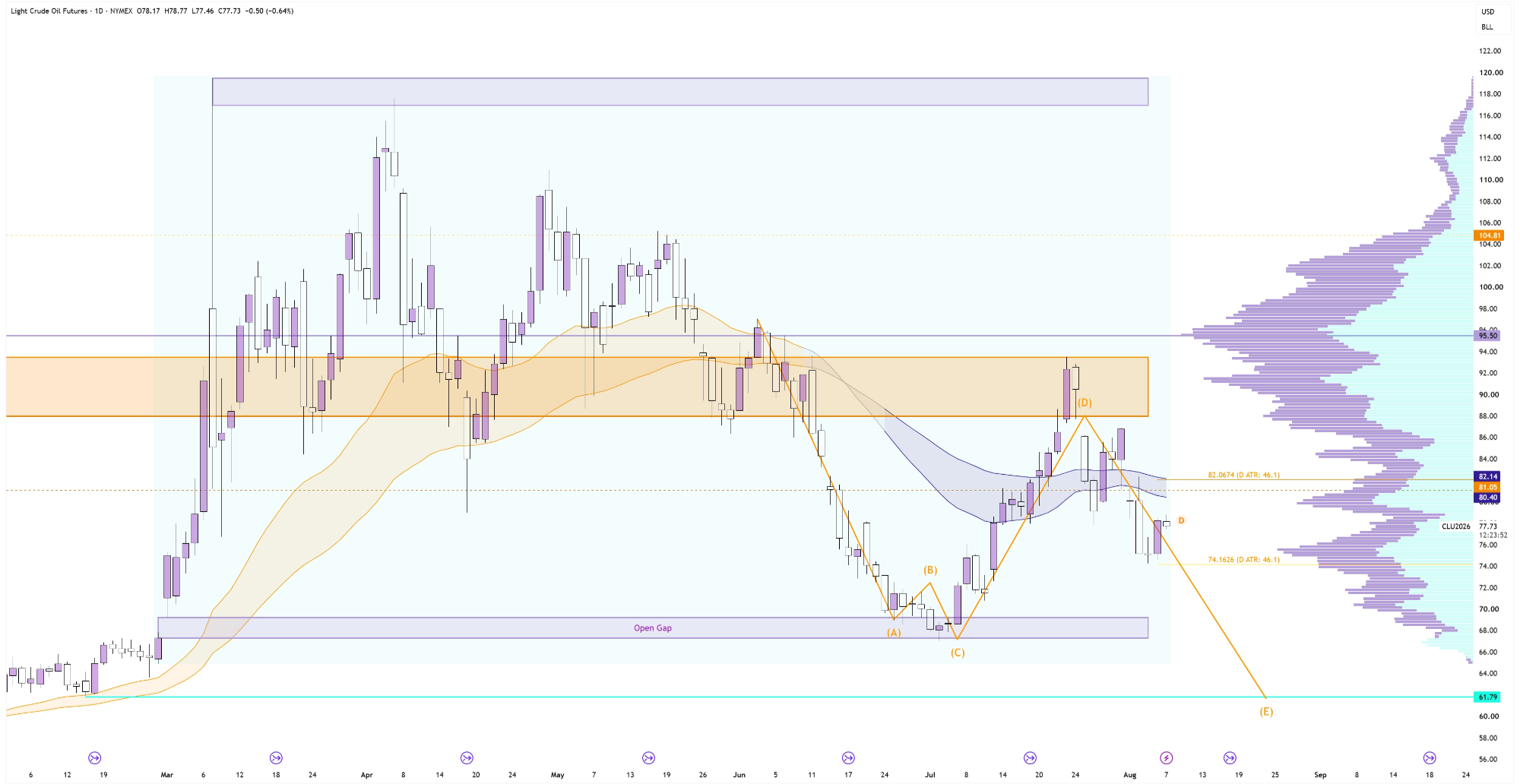
Further peace progress saw oil prices falling back, as the market is pricing out some of the geopolitical risk. Despite not knowing any of the news events, and how they would unfold in advance, we were able to anticipate the current price path a month in advance.
Oil on the Daily Timeframe
This is not because chart patterns have some magical energy, but because technical analysis is a study of psychology, and how human tendencies and emotions create repeatable patterns in financial markets.
The most likely view continues to be that leg E will resolve and price will slowly continue to its pre-conflict lows at $62. This move would especially be welcomed by central banks as they have been buying themselves as much time as possible, postponing any anticipated rate hikes.
A word of caution, trading is a matter of having a strategy and managing risks, the latter not being offset by any technical patterns, no matter how neat they appear to be. Always apply the appropriate risk management rules, set in line with your risk appetite and tolerance.
Conclusion
One-sentence summary of the week:
Bull Run Resumed, Lower Oil Hopefully Negates Expected Rate Hikes