As the benchmark industrial metal, copper is not to be overlooked. Its pro-cyclical tendencies and unique price action make it a compelling asset to trade. Copper is a volatile yet highly liquid asset, offering plenty of opportunities across various timeframes for different types of traders.
Trading Copper through Contracts for Difference
Before diving into the specifics of copper, a solid understanding of how CFDs work and how they differ from buying futures contracts is required. These are some of the key features of trading through a CFD:
- A CFD is a cash-settled derivative. This means you never physically buy, sell, or take delivery of any goods. You are speculating on a contract that is made to track the prices of copper futures in major markets. Using a CFD thus allows you to speculate on prices without ever having to worry about rolling over a futures contract or undertaking physical delivery.
- CFDs allow you to use leverage, enabling you to use your capital more effectively. Using leverage wisely allows you to hold multiple positions simultaneously without tying up all your capital in a single asset. It also allows you to size up positions and potentially make significant profit from intraday swings that would otherwise achieve only a small percentage gain. Leverage is a tool; when used wisely, it can amplify potential returns, but if used without understanding, it can also increase the size of losses.
- Unlike a physical investment, holding a CFD position past the daily market close typically incurs an overnight financing charge (or 'swap fee'). This cost makes holding positions for extended periods less profitable. Therefore, the strategies discussed below are more suited for short- to medium-term trades rather than longer-term investments.
Copper as a Leading Indicator for Equity Indices
For a long time, copper has held the nickname of ‘Doctor Copper’ due to its ability to diagnose global economic trends. Rationally, this link makes sense; copper is a critical input for construction, heavy manufacturing, and electrical equipment, which makes demand for copper (which is reflected through its prices) a real-time indicator for global economic activity.
Because of this, copper has historically possessed a high correlation with economic indicators like the US ISM Manufacturing PMI, and perhaps more interestingly, the S&P 500. We can empirically validate this claim by overlaying S&P prices onto a copper chart:
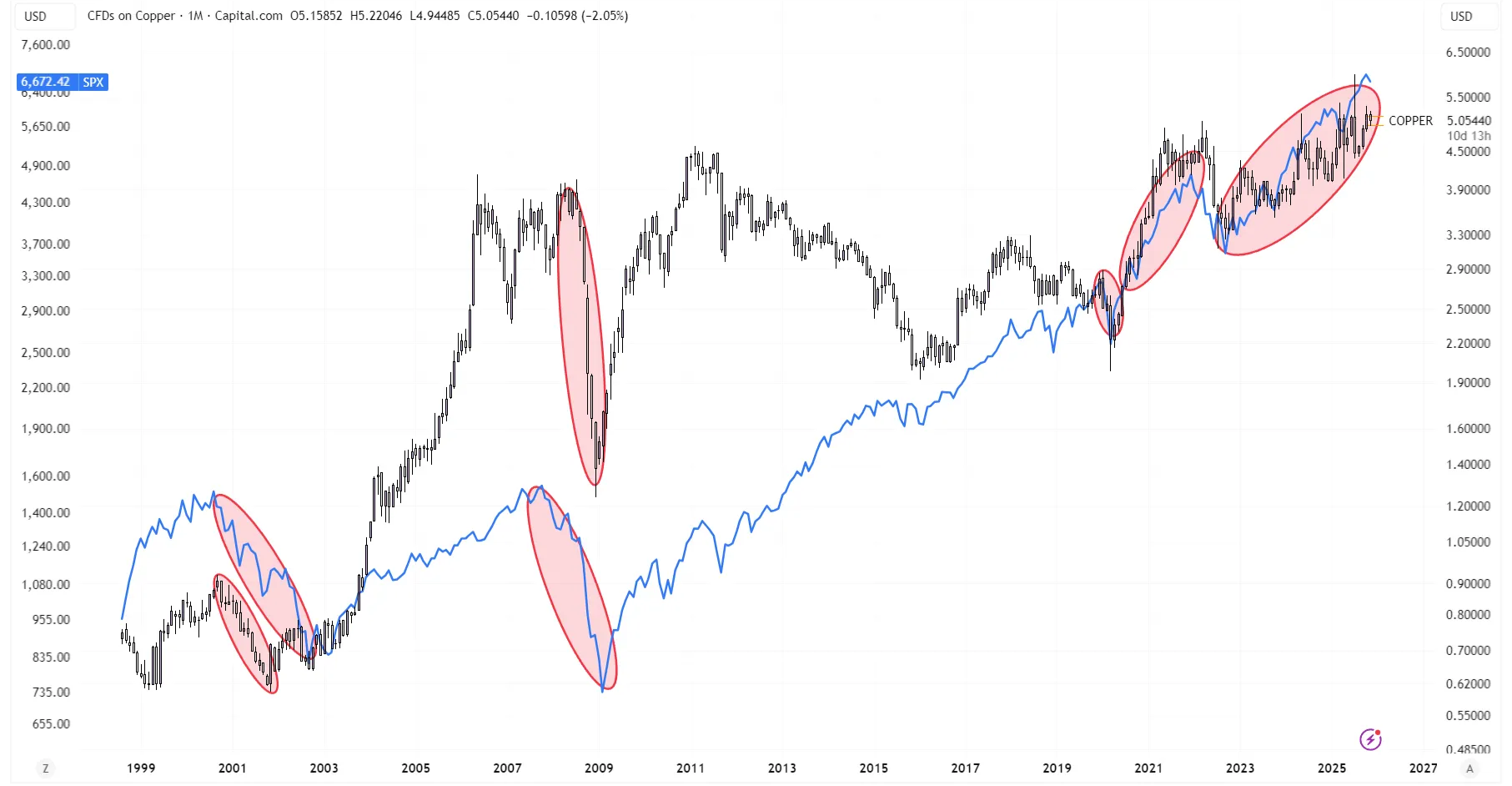
Monthly Logarithmic Copper chart overlaid with S&P 500 Prices
While this correlation isn’t perfect, we can see that in the overwhelming majority of cases, prices move in tandem. Copper’s strength as a leading indicator was proven in 2008 and 2022, where copper prices recovered more aggressively than the S&P 500, which quickly followed suit.
However, even this dynamic has its shortcomings. Supply-side disruptions, along with geopolitical forces, might create higher copper prices in a period where demand stays mostly flat, leading to traders and investors incorrectly anticipating higher prices in indices. Inversely, a big increase in supply might durably push prices down in a sustained trend, as we saw from 2011-2015. Blindly using copper prices without understanding the underlying drivers can thus be a costly mistake.
To assess whether Copper prices are reflecting economic strength, the focus should be on the demand for copper, rather than its overall prices. Even then, copper as a leading indicator is based on the premise that its demand is cyclical. However, with the rise of AI, Electric vehicles, and data centers, copper demand is seemingly becoming less cyclical, which could diminish its predictive power.
An Advanced Macro Signal: The Copper-to-Gold Ratio
One of the main issues with comparing Copper prices to the S&P 500 is that it’s easy to forget the effects of inflation. However, we can try to account for this by pricing Copper in terms of another hard asset: Gold.
This ratio effectively compares economic activity and risk-on appetite against a traditional store of wealth, and is seen as a safe-haven asset.
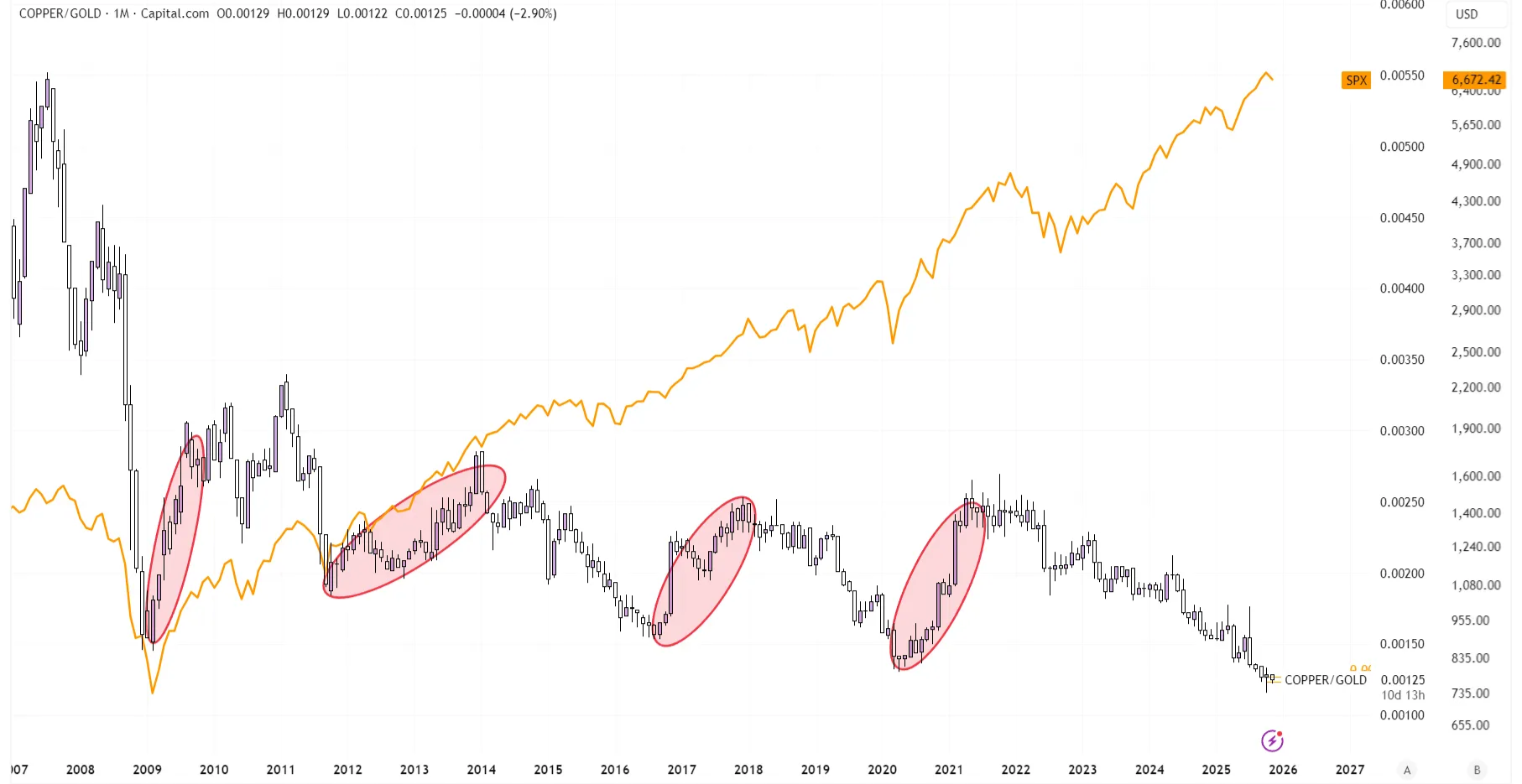
Copper/Gold overlaid with the S&P 500 on a Logarithmic scale since 2007
This chart can be tricky to interpret, so let’s break it down.
The first thing that you might notice is that COPPER/GOLD prices are in a sustained downtrend, which means that Copper, valued in terms of Gold, has gradually become cheaper. Empirically, we know this isn't purely indicative of the economy, as global growth has been significant since 2007. Instead, we can conclude that Copper has become cheaper in real terms, perhaps due to technological advancements.
The periods on which to focus are thus where prices move in the opposite trend, i.e., to the upside. In 2009, Copper/Gold prices found their bottom three months before the S&P 500 did, and throughout 2009, it led the way for the S&P 500, consistently moving ahead of it by a couple of weeks.
In 2011, a similar pattern emerged. Copper/Gold started dropping well before the S&P 500 and served as a leading indicator for the subsequent recovery during 2012. This pattern appeared again in 2016: the S&P 500 was in a downtrend, while copper was aggressively moving up. Throughout the 2017 bull run, copper prices almost always led the S&P 500 by several weeks.
Most recently, this pattern emerged following the 2020 COVID recession. Initially, copper lagged as equity indices priced in monetary easing. However, when economic activity resumed, copper prices rose 63% (measured in gold) over six months, firmly signaling the subsequent price action for the S&P 500 in 2021; one of its best years in recent history.
This ratio is arguably superior as a macroeconomic signal compared to standard USD copper prices because it filters out the effects of currency debasement. While often overlooked, it can be a highly effective tool for predicting economic strength.
Demand Structure: The old-world and the AI economy
The Old World
While new sources of demand are catching headlines, it is important not to forget the traditional bedrock of copper usage. This is dominated by the building and construction sector, which accounted for roughly 45% of all copper use in the U.S. in 2023.
This includes essential applications in electronics, industrial machinery, transportation, power infrastructure, and plumbing. This demand sector alone is expected to grow by 19% from 2024 to 2050. Furthermore, this area provides a stable long-term price floor, helping to buffer prices against the uncertainties of emerging technologies.
Electric Vehicles and the Energy Transition
Looking towards future expected demand, a huge part of this puzzle is the shift towards a green economy. Green technologies require multiple times more copper per unit of output than their fossil-fuel predecessors, exactly because it’s such a good electrical and thermal conductor, which is what electric energy needs.
For example, an electric car requires 2.5 to 4 times as much copper as a conventional internal combustion engine vehicle, with this difference being even larger for high-performance models.
The same story holds up for power generation. Wind and solar energy require 4-5 times as much copper per megawatt as fossil fuel energy. A single onshore wind turbine contains approximately 4.7 to 5 tonnes of copper, at current prices, which is a cost of $51,690-54,990. These numbers clearly indicate the volume of demand expected during this global green transition.
However, the most important factor of this additional demand is that it’s relatively price inelastic. The green transition is mandated through regulation, which means that Copper demand will likely continue to be substantial, even as prices rise.
The New Tech Demand
As if the green energy transition wasn’t enough of a bullish catalyst, the explosive boom in AI has created a second, unforeseen consumer of copper: the construction of huge data centers.
The power requirements for AI are substantial. Because of that, copper demand is also high. Current estimations suggest that demand for copper in these applications will increase sixfold by 2050. For example, a single hyperscale data center requires up to 50.000 metric tonnes of copper ($549,900,000 at current prices).
Just like the green transition, this demand is expected to be relatively inelastic. Tech giants racing to become the new AI leaders cannot afford delays in data center construction. They are likely to pay whatever price is necessary to succeed.
This creates an extremely interesting bullish backdrop for copper, following the age-old adage: "During a gold rush, sell shovels."
Supply: A Looming Deficit
A Concentrated Supply Chain
Over half of all copper reserves are located in Chile, the Democratic Republic of Congo (DRC), Peru, Australia, and Russia. The market is even more concentrated at the corporate level, where production is dominated by four major players:
- Codelco
- Freeport-McMoRan
- BHP Group
- Glencore
Because production is so consolidated, localized events can have an immediate impact on prices. A new mining tax law in Chile, community protests in Peru, or political instability in the DRC are front-page, tradable events for specialized copper traders. Incidents at a single mine could instantly tighten the entire global supply.
Geological Constraints
Perhaps the most significant long-term supply constraint is declining ore grades. What we could consider to be the easy copper has already been mined. Current operations must dig deeper, in more remote locations, extracting lower average ore grades. All of this makes mining more expensive.
Additionally, setting up new large-scale copper mines takes a lot of time, often 10-15 years. This means that short-term price spikes cannot be quickly absorbed by increased supply.
This combination of higher production costs and a supply structure that is inherently inelastic to price in the short-to-medium term creates a structural floor under prices. The race towards AI dominance and the green transition is underway now, and yet supply seems incapable of durably increasing for several years
The Balance Sheet
Price is an equation of supply and demand.
- Demand Side: Stable old-world demand + The Green Transition + The AI Arms Race
- Supply Side: Geological constraints + Inelastic Supply + Concentrated Geopolitics
These factors suggest the market may shift into a structural supply deficit. While copper recycling is picking up pace, it is unlikely to meet all anticipated demand in the coming years.
Another factor that can help stabilize prices is substitution. In some areas, aluminum is a viable (though less efficient) substitute. The extent to which copper will be substituted is highly dependent on copper and aluminum prices, as the less-efficient characteristics of aluminum mean companies require a significant premium on copper prices before they have enough economic incentive to switch to aluminum.
Despite these stabilizing factors, the macro view suggests a long-term structural bullish bias for copper.
Advanced Tools
Contango vs. Backwardation
The futures curve consists of contract prices for different delivery months. It reveals the market's true expectations regarding term structure, supply, demand, and storage costs.
There are two types of market structure:
- Contango: This is the "normal" market structure, where prices further in the future are higher than the current spot price. This signals the market is well-supplied or the cost of carry (storage/insurance) is high. Essentially, the market pays a premium for future delivery to avoid physically holding the metal today.
- Backwardation: This is the opposite scenario. The futures price is lower than the spot price. This implies physical short-term supply is constrained; buyers are paying a premium to get the metal now rather than later. This signals a stressed environment.
Even for CFD traders, monitoring the futures curve is crucial. A market in backwardation indicates tight short-term supply and is effectively a bullish indicator.
Warehouse Stocks
These are the physical inventory levels in the London, U.S., and Shanghai futures markets. These stocks are approved physical inventory in the warehouses of the derivatives exchange and serve as a direct measure of physical supply availability.
Gradually tightening supply supports aggressive upward price moves, as there is little immediate inventory to buffer unexpected demand. Inversely, a sharp rise in inventories signals a well-supplied market, likely pushing the futures curve back into contango.
Regional Premiums
Anyone who has looked at Copper prices in LME (London), COMEX (U.S.), or SHFE (Shanghai) might have noticed that prices across the venues aren’t the same, even when accounting for the different currencies and contract sizes.
This is a structural tendency, and we can thus conclude that not all copper is priced the same. Certain geographical areas can create premiums over other types. The best-known example is that of the “Yangshan premium”, which represents the premium for imported copper arriving in China over the LME price.
These divergences reflect physical market dislocations, often driven by geopolitics. Traders who are attentive enough to catch these dislocations can occasionally come across very high reward setups, with very little risk.
Price Dynamics
Copper is inherently volatile. This volatility is a function of its necessity in production, supply-side shocks, and high geopolitical concentration.
Volatility is a double-edged sword; it creates more opportunities under generally lower costs (higher volatility requires smaller positions for the same % risk exposure), but it is also easier to burn those who do not employ sound risk management.
On top of the volatility risk, traders should also consider correlation. As we talked about earlier in this article, Copper and Equity Indices are strongly linked. Due to Copper’s role as a leading indicator, it’s an interesting asset to trade, but it also carries extra risk. A trader who is long on both the Nasdaq and Copper, for example, really has double the exposure to risk-on assets.
As the market share of the Tech giants in equity indices continues to rise, this correlation is also expected to grow even stronger. Any release from major AI companies about the building of data centers will likely lead to similar movements in both assets.
Concluding Synthesis
Copper is a very lucrative asset to trade, due to its tendencies as a leading indicator and its high volatility. Furthermore, the current supply and demand structure points towards a very strong bullish bias, which opens up possibilities for traders who can combine this fundamental analysis with a well-timed entry.
Market dynamics are shifting, largely driven by new tech demand. This will likely lead to deviations in price behavior compared to the past, offering opportunities for those who can anticipate these shifts. In general, copper is a challenging but potentially very profitable market for those willing to specialize in it.
Ready to capitalize on the AI Supercycle? Join Axiory and employ our tight spreads to ‘sell the shovels’ in the AI boom.